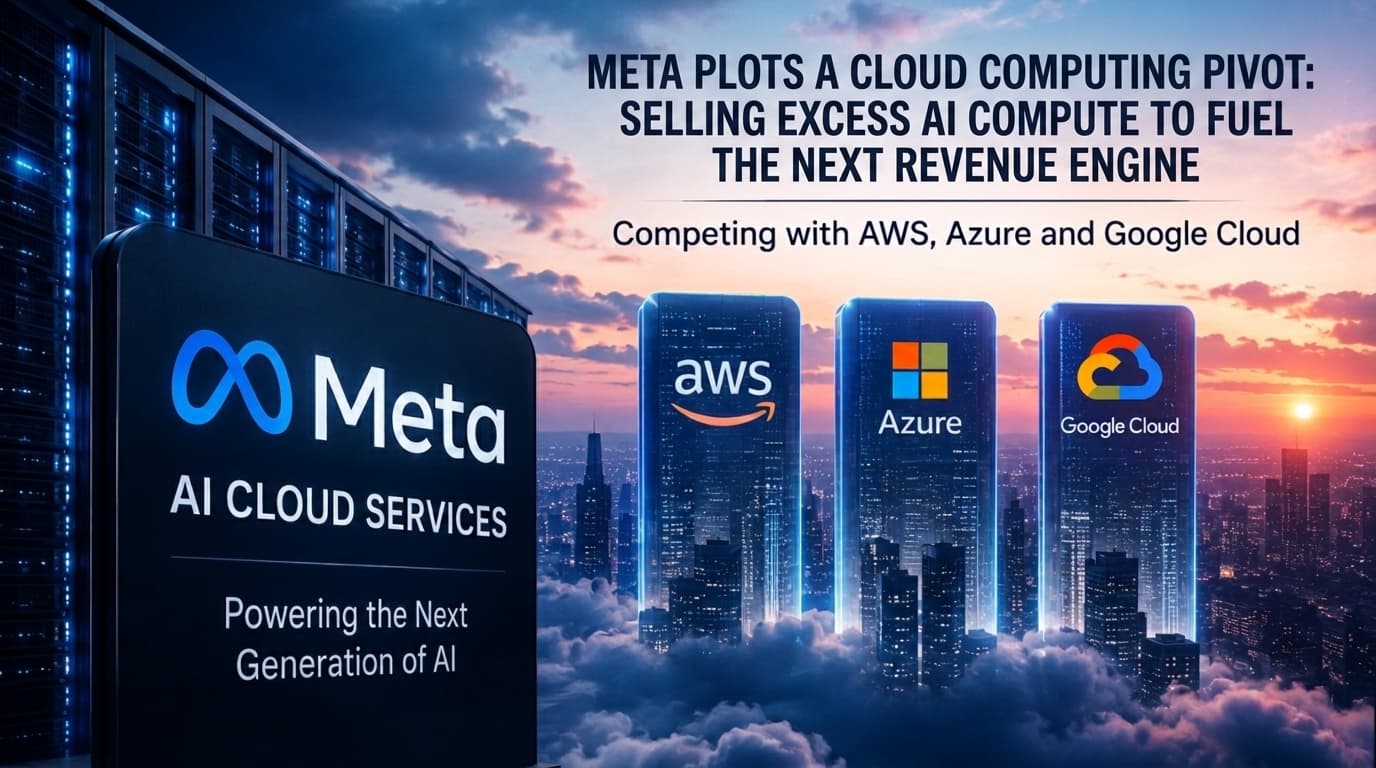
Meta is quietly preparing to enter the cloud computing market in a bold and unorthodox way: by renting out the staggering surplus of artificial intelligence computing power that it built for its own internal ambitions. According to a new report, the parent company of Facebook, Instagram, and WhatsApp is developing a dedicated cloud business unit designed to sell idle AI processing capacity to external customers, turning a colossal capital expense into a potential multi-billion-dollar revenue stream.
For years, Meta has been one of the world’s most aggressive buyers of Nvidia GPUs and custom AI silicon, accumulating one of the largest private concentrations of high-performance computing infrastructure on the planet. That infrastructure was originally assembled to power internal workloads—training massive language models like Llama, running real-time recommendation algorithms across its family of apps, and building the metaverse. But as Meta’s AI infrastructure has scaled far beyond its immediate internal needs, the company has recognized a lucrative opportunity: there are thousands of enterprises hungry for AI compute that don’t want to buy and manage their own hardware.
The strategy, still in its early stages, would see Meta offer on-demand access to GPU clusters, AI training and inference capacity, and specialized machine learning development environments through a cloud-like platform. Rather than competing head-on with Amazon Web Services, Microsoft Azure, or Google Cloud in the general-purpose cloud space, Meta would carve out a niche as an AI-specialized infrastructure provider—essentially an “AI cloud” focused entirely on training and deploying large models. Early indications suggest the service could launch in a closed beta with select partners before the end of 2026, with broader availability planned for 2027.
The economics behind the move are compelling. Meta’s capital expenditures on AI infrastructure have ballooned to tens of billions of dollars annually, a figure that has drawn sharp scrutiny from Wall Street. By monetizing compute that would otherwise sit idle during off-peak internal usage periods, Meta can improve its return on invested capital while simultaneously deepening its ties to the developer ecosystem. Every external customer training a model on Meta’s infrastructure is a potential adopter of Llama models, PyTorch tools, and Meta’s broader open-source AI stack—creating a powerful flywheel of influence and revenue.
Industry analysts view the move as a natural evolution, though not without risk. Meta has no history of selling infrastructure services, and cloud computing is a fiercely competitive, low-margin business dominated by entrenched players with decades of operational experience. Building the enterprise sales, support, and compliance frameworks needed to serve paying business customers will require a significant cultural shift for a company accustomed to serving consumers and advertisers. Questions around data privacy, model security, and service-level guarantees will also need to be addressed before large enterprises trust Meta with their most sensitive AI workloads.
Yet the potential upside is enormous. The global market for AI cloud services is projected to surpass $150 billion by 2030, driven by companies that lack the capital or expertise to build their own GPU clusters. Meta’s existing data center footprint, combined with its expertise in operating some of the world’s most demanding AI workloads at scale, gives it a unique competitive advantage. If the company can package that capability into a reliable, competitively priced cloud product, it could siphon significant market share from traditional cloud vendors—especially among startups and mid-sized firms looking for a more cost-effective path to AI development.
The initiative also aligns neatly with CEO Mark Zuckerberg’s broader vision of positioning Meta at the center of the AI ecosystem. Open-sourcing models like Llama has already given Meta an outsized influence in the developer community; providing the compute to run those models would tighten that grip. In many ways, Meta’s cloud ambitions echo Amazon’s original playbook: take excess internal capacity, package it as a service, and eventually build a dominant external business. The difference is that Meta’s starting point is AI compute, not generic storage and virtual machines.

Not everyone is convinced. Skeptics point out that Meta has a history of launching and abandoning ambitious side projects—from its ill-fated smartphone to its failed attempt at a cryptocurrency. A cloud business demands patience, sustained investment, and a relentless focus on customer service, all of which run counter to Meta’s historically fast-moving, product-centric culture. The company will need to prove it can operate with the reliability of a top-tier cloud provider before major clients commit serious workloads and budgets.
For now, the signals are clear: Meta is serious about commercializing its AI infrastructure. Job postings for cloud infrastructure engineers, enterprise sales leads, and compliance specialists have proliferated in recent months, and internal teams have been tasked with building the foundational billing, provisioning, and multi-tenancy systems that a cloud service requires. The pieces are being assembled deliberately, away from the spotlight of quarterly earnings calls.
If Meta succeeds, it could reshape the competitive dynamics of both the cloud and AI industries. A well-capitalized entrant with direct access to leading-edge GPUs and a vast open-source model library would pressure incumbents to lower prices and accelerate innovation. It would also create an intriguing new revenue pillar for Meta—one less dependent on advertising and more tethered to the long-term infrastructure needs of the AI economy. The message is unmistakable: Meta isn’t just building AI for itself anymore; it’s building a platform for the world to build with it.